

Key Takeaways
- San Francisco’s fog, humidity, and compact living conditions create specific challenges for apartment rugs that most generic guides don’t address.
- Grit and sand trapped in rug fibers act like sandpaper and cause lasting fiber damage long before a rug looks visibly dirty.
- The right rug pad, rotation schedule, and vacuuming technique each play a real role in extending rug life between professional cleanings.
- Fringe unraveling, edge curling, and fiber thinning in high-traffic zones are repair problems, not just cosmetic ones. Catching them early saves money.
- Professional deep cleaning using a submersion-based process is fundamentally different from on-site carpet cleaning and produces much better results for area rugs.
- Residential rug cleaning with pickup and delivery makes professional care accessible for apartment dwellers throughout the Bay Area.
If you live in a San Francisco apartment, your rugs are working harder than most people’s. Narrow entryways funnel all foot traffic over the same two square feet. Open floor plans mean a single living room rug doubles as dining space, dog territory, and home office. And the Bay Area’s famous coastal fog doesn’t help: the damp, cooler air that rolls through SF neighborhoods creates conditions where moisture lingers in fibers, making rugs slower to dry and more prone to odor after a spill.
We’ve worked with rugs from apartments across the city, and there’s a pattern we see repeatedly: rugs that look pretty good on the surface but are quietly accumulating damage at the fiber level. The good news is that most of this is preventable, and even rugs that are already showing wear can usually be brought back.
Here’s what actually works.
Understand What High-Traffic Does to Rug Fibers
This is the part most rug care guides skip over. People think a rug “gets dirty,” and they’re not wrong, but grit and sand are the real problem. Every time someone walks across a rug, the fine particles embedded in the pile grind against individual fibers. Over time, that mechanical abrasion breaks fibers down from the inside out. By the time you notice thinning or matting, the damage has been accumulating for months or years.
This is especially relevant in San Francisco apartments. City streets track in more particulate matter than suburban neighborhoods, shoes pick up more grit, and smaller entryways mean less transition space between outside and inside. If your front door opens directly onto your main rug, that rug is taking the full hit.
Vacuuming regularly, ideally once or twice a week in true high-traffic zones, is the primary line of defense. But technique matters. Slow passes pull more embedded soil out than fast ones. For wool or hand-knotted rugs, turn off the beater bar and use suction only; aggressive agitation pulls at natural fibers. And don’t skip vacuuming the back of the rug occasionally. Flipping it over and running a vacuum pass along the backing dislodges packed dust that’s nearly impossible to reach from the face.
The Fog Problem: Humidity and Your SF Rug
San Francisco’s microclimate is genuinely different from the rest of the Bay Area. Neighborhoods like the Outer Sunset, Inner Richmond, and Noe Valley see persistent fog that keeps indoor humidity elevated for much of the year. The U.S. EPA recommends keeping indoor relative humidity between 30 and 50 percent to minimize mold growth and dust mites. In a fogged-in SF apartment without great ventilation, staying in that range can be a real challenge.
Why does this matter for rugs? Moisture is one of wool and silk fibers’ biggest vulnerabilities. A damp rug that never fully dries between uses becomes a place where dust mites thrive and mildew can start to develop in the foundation. The EPA notes that house dust mites grow in damp, warm environments and are among the most powerful biological allergens found in homes. You won’t see the problem forming, but you’ll eventually smell it, or start sneezing more.
If your apartment runs on the damp side, a few habits help: keep windows open when the fog burns off in the afternoon, use a bathroom exhaust fan after showers, and when a rug gets wet from a spill or cleaning, get it elevated off the floor and drying as fast as possible. Don’t lay a wet rug flat against a hard floor.
Build a Rotation Habit
Here’s a simple one that most people genuinely don’t do. Rotating your rug 180 degrees every six months makes a real difference.
In most apartments, the heavy foot traffic always hits the same zone. The path from the door to the couch, the area in front of the kitchen counter, the spot where everyone puts their bag down. One side of the rug ends up compacted and faded while the other stays relatively fresh.
Rotation distributes the wear more evenly, extends the time between professional cleanings, and gives you a more accurate picture of the rug’s actual condition. When you rotate and notice that one end of the rug is dramatically more worn than the other, that’s useful information.
Spot Cleaning: What Not to Do
When a spill happens, blot it. Don’t rub it. Blotting lifts the liquid out of the fibers; rubbing pushes it deeper and spreads the stain laterally. Use a clean cloth and work from the outer edge of the spill inward.
Some popular DIY remedies cause more problems than they solve. Baking soda, for example, is often recommended as a quick deodorizer. But fine particles can lodge deep in wool pile and are difficult to remove without professional equipment. Harsh detergents, bleach-based cleaners, and anything with a high pH can strip dyes, particularly in vegetable-dyed Persian and Oriental rugs. When in doubt, cold water and blotting are safer than any product.
For pet accidents specifically, the real problem isn’t the surface stain. It’s that urine soaks down through the pile and into the rug’s foundation, where it stays. Surface cleaning addresses what you can see; it doesn’t reach what you can’t. That’s a job for professional pet stain and odor removal with equipment and treatments designed to reach the rug’s foundation.
Use a Quality Non-Slip Pad
A good rug pad isn’t just a safety measure. It protects the rug itself.
When a rug slides on a hard floor, the backing scrapes against the surface thousands of times a day. That friction wears down the rug’s foundation and causes edge curling, which then becomes a tripping hazard and an accelerated damage point. A proper non-slip pad keeps the rug stable and acts as a cushion that absorbs some of the impact load from foot traffic.
In apartment settings, where hardwood and tile floors are common, a pad is essentially non-negotiable if you want your rug to last. We offer non-slip rug pad installation cut to the exact dimensions of your rug, which makes a noticeable difference compared to off-the-shelf pads that rarely fit correctly.
Know the Warning Signs That Require Professional Repair
Most apartment dwellers are pretty good at noticing when a rug looks dirty. Fewer people know what physical damage to look for. And physical damage, when ignored, typically gets worse faster.
Fringe Unraveling
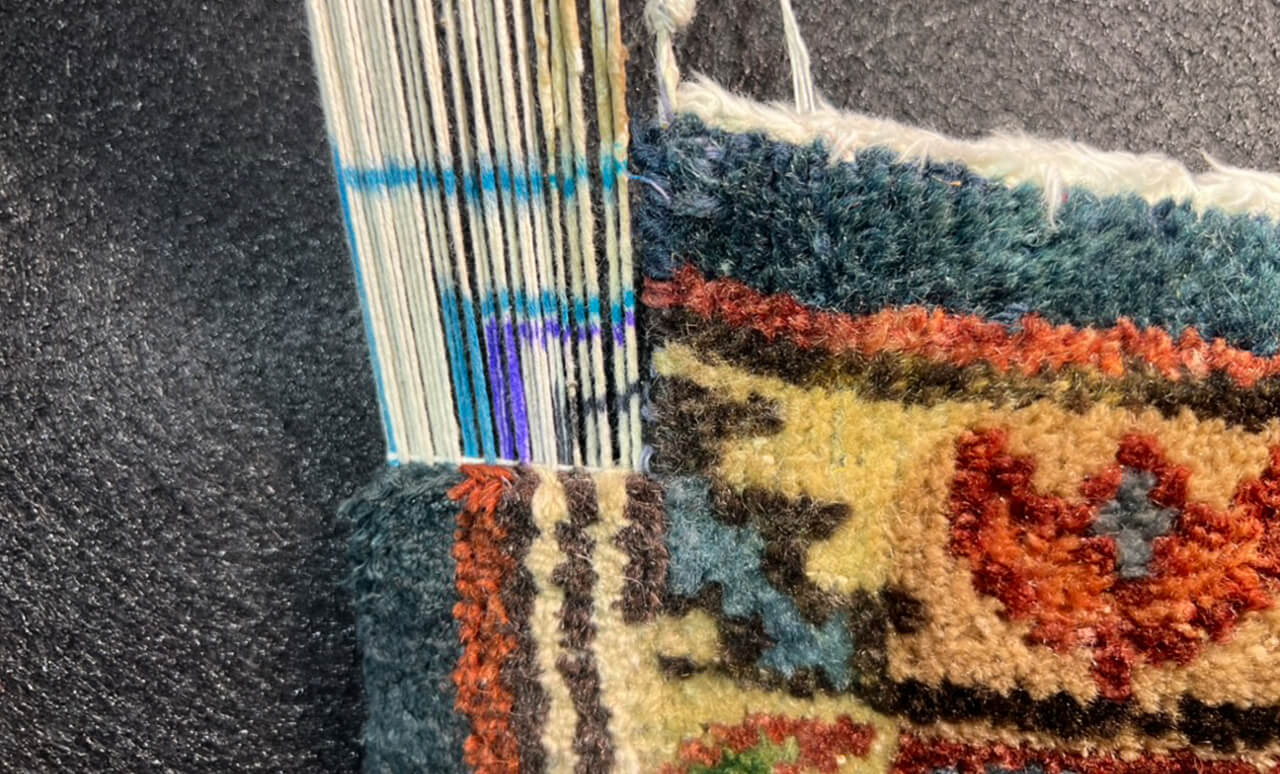
Fringe on a hand-knotted rug isn’t decorative. It’s the actual warp threads of the rug, and when they start to fray or unravel, the structural integrity of the rug is at risk. In high-traffic apartments, fringe at the ends of a rug gets stepped on constantly. What starts as a few loose threads can become a spreading unravel that compromises the whole end of the rug.
Fringe restoration done early is a straightforward repair. Left alone, it turns into a much bigger and more costly problem.
Edge Curling and Binding Wear
Curled edges and worn binding are common in high-traffic areas. A rug that curls at the corner gets stepped on wrong, catches on chair legs, and accelerates its own damage. Overcasting stitching or new edge binding stabilizes the rug and stops the deterioration.
Thinning or Bare Spots
If you can see the rug’s foundation through the pile in any area, that’s wear damage, not just dirt. Depending on the extent, reweaving can restore the rug. But the window for effective repair narrows as the damage spreads.
When to Schedule Professional Cleaning
For most San Francisco apartment rugs in genuinely high-traffic positions, professional cleaning once every one to two years is a reasonable general guideline. Rugs that live near the front door, under a dining table, or in a home with pets or kids are on the more frequent end of that range.
What you can’t accomplish with vacuuming alone is a true deep clean. Embedded grit, allergens, bacteria from pet accidents, and odors that have soaked into the foundation require immersion-based professional methods. Our process at The Rug Guardians uses a custom submersion system that cleans up to 5x more effectively than standard on-site carpet cleaning equipment. Every rug is fiber-tested first, then dusted, hand-washed, and dried in a controlled environment to prevent mold. For apartments in fog-prone neighborhoods, that controlled drying environment is particularly important.
We also offer pickup and delivery throughout San Francisco, so you don’t have to figure out how to transport a heavy area rug in a city where parking and stairwells are both a challenge.
Ready to Restore Your Apartment Rug?
Get a Professional Assessment from The Rug Guardians
Whether your rug needs a thorough cleaning, a repair to a worn edge, or both, we can help. We work with all rug types, from hand-knotted Persian and Oriental rugs to modern wool and synthetic area rugs. Contact us to schedule a pickup and get an honest assessment of what your rug needs.
Frequently Asked Questions
How often should I professionally clean a rug in a high-traffic San Francisco apartment?
For most high-traffic positions, like an entry area or living room in a busy household, professional cleaning every one to two years is a practical range. Rugs that see pets, children, or particularly heavy use may benefit from annual service.
Can San Francisco’s fog and humidity actually damage rugs?
Yes, over time. Persistent moisture slows drying after spills and creates favorable conditions for dust mites and mildew in the rug’s foundation. Rugs in fog-heavy neighborhoods like the Outer Sunset or Inner Richmond are particularly susceptible, especially if the apartment has limited ventilation.
What’s the difference between professional rug cleaning and carpet cleaning?
Standard carpet cleaning uses surface extraction, which addresses the top of the fibers. Professional rug cleaning, especially a submersion-based process, reaches the full depth of the rug, including the foundation where odors, allergens, and deep soil accumulate. It’s a fundamentally different level of cleaning.
Is fringe damage a cosmetic issue or a structural one?
It’s structural on hand-knotted rugs. The fringe is made from the rug’s own warp threads. When those threads unravel, the rug itself can begin to deteriorate at the ends. Getting fringe repaired early is almost always significantly cheaper than waiting.
Can pet urine smell be completely removed from a rug?
Professional treatment that reaches the rug’s foundation can neutralize the odor at its source in most cases. Surface cleaning alone won’t do it, because urine soaks through the pile and into the backing. The sooner the rug is professionally treated after an accident, the better the outcome tends to be.
Do I need a rug pad on hardwood floors in my apartment?
Yes, and for more than slip prevention. A pad reduces the friction between the rug’s backing and the floor, which protects both. It also absorbs some of the impact from foot traffic, which helps the rug last longer between cleanings and repairs.
What types of rugs are most vulnerable to high-traffic damage in apartments?
Hand-knotted wool and silk rugs, antique and vintage rugs, and rugs with vegetable-based dyes tend to be the most vulnerable to both mechanical wear and improper cleaning. That said, any rug placed in a genuinely high-traffic zone without a pad, regular vacuuming, and periodic professional cleaning will show accelerated wear over time.