

Key Takeaways
- Sun fading is cumulative and permanent. Once a rug’s dye breaks down, no cleaning process can bring the original color back.
- Standard window glass blocks most UVB rays, but a large share of UVA still gets through, and UVA is a major driver of long-term fading.
- Bay Area homes are especially exposed because of big view windows, open floor plans, and long stretches of clear afternoon sun once the fog burns off.
- Natural dyes in hand-knotted Persian, Oriental, and vegetable-dyed rugs are more sensitive to light than most synthetic fibers.
- Rotating your rug, using UV window film or blinds, and adding a quality rug pad are the most practical, affordable defenses.
- If fading has already started, professional color correction and re-dyeing can often restore a rug’s appearance, though prevention is always cheaper than repair.
Why This Is Such a Common Problem in San Mateo and Santa Clara County Homes
If you live in San Mateo or Santa Clara county, you know the drill. Morning fog rolls in, burns off by late morning, and then you get hours of strong, direct sun with barely a cloud in sight. Great for the backyard. Rough on your rug.
We see this pattern constantly in the homes we work in throughout our service areas. Newer Bay Area homes tend to have large picture windows, sliding glass doors, and open concept living rooms that face west or south to catch the view. That’s exactly the kind of light exposure that ages a rug fast.
Here’s the part most people don’t realize: glass doesn’t block the sun’s fading power the way you’d think. Standard residential glass blocks the majority of UVB radiation, the type responsible for sunburn. But a meaningful percentage of UVA still passes right through, according to the Health Physics Society. UVA doesn’t cause sunburn, but it’s a major contributor to color breakdown in fabric, wood, and rug fibers over time.
So even if your rug never sits in a literal sunbeam, if it’s near a bright window for years, it’s absorbing more UV than you’d guess.
What’s Actually Happening to the Fibers
Fading isn’t just a surface issue. Sunlight breaks down the chemical bonds that hold dye molecules together. Once that bond is broken, the color doesn’t come back. It’s gone.
Conservation experts who care for museum-grade textiles treat this as settled science. The National Park Service’s guidance on textile care notes that light damage to textiles is cumulative and irreversible, and recommends keeping illumination on sensitive textiles as low as 50 lux where possible, which is far dimmer than a sunlit living room. The Northeast Document Conservation Center makes a similar point: sunlight isn’t recommended as a light source for valuable objects because it’s intense, causes extensive fading, and carries a high UV component that damages materials at a chemical level.
Your rug obviously isn’t a museum piece sitting in a glass case (although, if it’s a family heirloom, it might be close). But the underlying mechanism is the same one that fades a display textile.
A few things make some rugs more vulnerable than others:
- Natural and vegetable dyes used in traditional Persian and Oriental weaving tend to be more light-reactive than synthetic dyes.
- Reds, purples, and deep blues typically show fading faster and more visibly than neutrals like tans and creams.
- Silk fibers are naturally more delicate and can show sun damage in both color and fiber strength before wool does.
- Synthetic fibers hold up better against UV in general, but even these will dull with enough sustained exposure.
Not sure what your rug is made of? That matters more than people think when it comes to fade risk. It’s one of the first things we check during any Persian and Oriental rug cleaning evaluation, since fiber type changes both how a rug fades and how it should be cleaned.
How to Tell if It’s Sun Fading (and Not Something Else)
This trips a lot of homeowners up. Discoloration can come from several different causes, and they don’t all need the same fix.
Sun fading usually shows up as a gradual, even lightening of color in the areas that get the most light. Look at the edge of a rug near a window versus the section tucked under furniture. If there’s a visible line or gradient where the color is noticeably brighter in the shaded spot, that’s a strong sign of light damage.
Compare that to color bleeding, which tends to show up as blotchy, migrating patches of color, often after a spill or improper cleaning. Or general soiling, which dulls the whole rug evenly and usually improves dramatically after a deep clean. Sun fading, on the other hand, won’t come out in a wash. It’s a structural change in the dye itself.
One more clue: sun-faded rugs often look brighter and more saturated once you flip a section over or check underneath furniture that’s never moved. If the color underneath looks like a different rug entirely, you’re looking at fading, not dirt.
Practical Ways to Protect Your Rug
None of these require ripping out your beautiful windows. Most are simple habit changes.
Rotate your rug every few months. This is the single easiest fix. Turning your rug 180 degrees every three to six months spreads out sun exposure so one section doesn’t take all the damage. Set a phone reminder if you need to. Most people forget.
Use UV-blocking window film or treatments. Quality UV window film can filter out a large share of the UVA that standard glass lets through, cutting down on the fading rate for everything near that window, not just your rug.
Close blinds or sheers during peak sun hours. In the Bay Area, that’s typically late morning through mid-afternoon once the marine layer clears. Even light, sheer curtains cut down on direct exposure without blocking your view completely.
Reposition furniture and rugs seasonally. If your living room gets brutal afternoon sun in summer, consider shifting the rug’s position or adding a runner in the hot zone instead of your best piece.
Add a quality rug pad. This one’s more about even wear than fading specifically, but it matters. A pad keeps the rug flat and prevents the kind of shifting and buckling that leaves parts of a rug crumpled and exposed to light unevenly. We install non-slip rug pads as part of a lot of our service calls for exactly this reason.
Keep valuable or antique rugs out of direct light entirely, if you can. For your most treasured pieces, a hallway or a room with north-facing windows is a much safer long-term home than a sunroom.
What if the Fading Already Happened?
It happens. Even careful homeowners end up with a rug that’s noticeably lighter in one corner after a few years near a bright window.
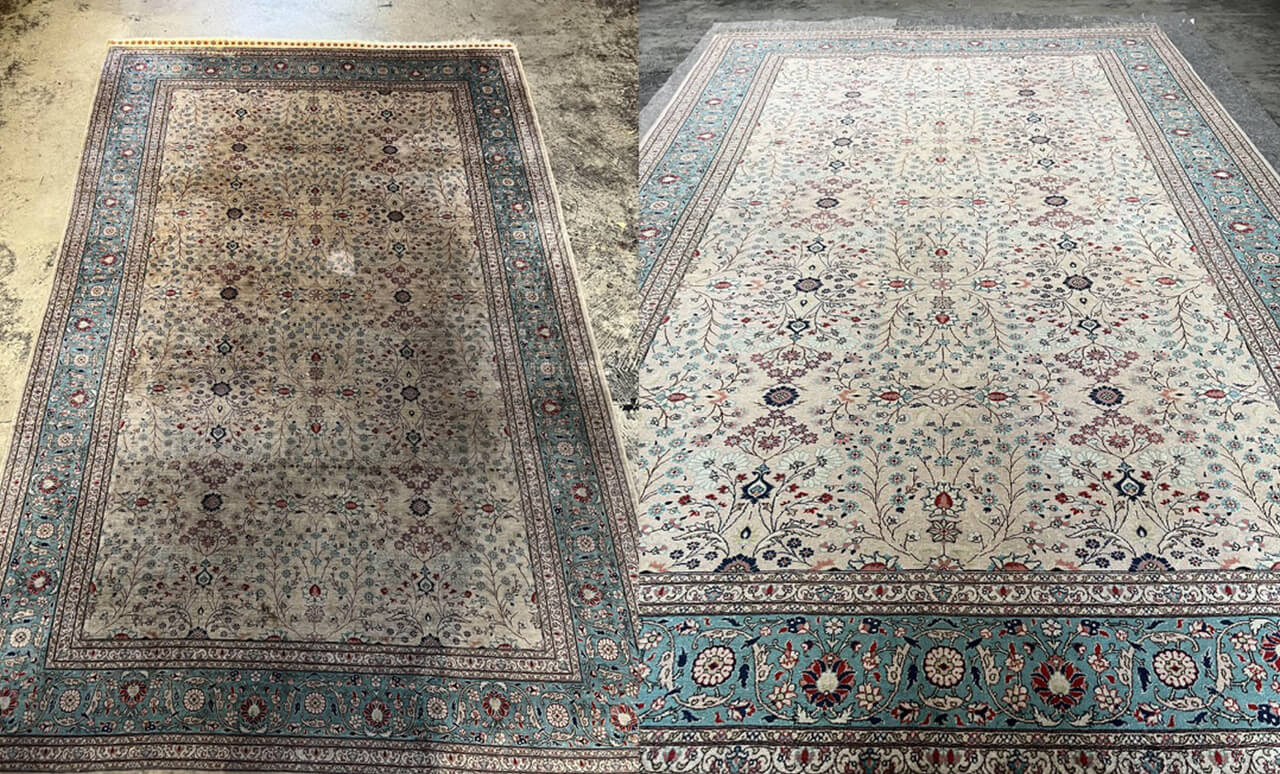
The good news is that fading isn’t always the end of the story. Our team performs color bleed correction and dye restoration work using custom-blended, colorfast dyes to bring faded or damaged sections back in line with a rug’s original palette. We’ve restored antique Persian rugs, vegetable-dyed pieces, and contemporary rugs with this exact issue, matching intricate patterns and borders by hand rather than guessing at a close-enough shade.
If you’re dealing with visible sun damage, our color correction and dye work service is the right place to start. We inspect the rug, test dye stability, and walk you through what’s realistically achievable before any work begins.
One thing worth being upfront about: not every fade is fully reversible. Severe, long-term UV damage can weaken fibers along with color, and in those cases, restoration focuses on the best achievable result rather than a guaranteed like-new finish. We’ll always tell you honestly what to expect before we start.
Give Your Rug the Protection It Deserves
Sun damage sneaks up slowly, and by the time it’s obvious, it’s already been happening for months or years. If you’re not sure whether your rug is at risk, or you’re already seeing signs of fading, our team at The Rug Guardians can take a look and walk you through your options, from simple prevention habits to full color restoration.
Contact us today to schedule an evaluation and get a straight answer about what your rug needs.
FAQ
Does sun fading affect all rug materials the same way?
No. Wool tends to hold color reasonably well compared to silk, which is more delicate and can show both color and fiber damage sooner. Synthetic fibers generally resist UV fading better than natural fibers, though none are completely immune.
Can a faded rug be restored to its original color?
Often, yes, through professional color correction and re-dyeing. Results depend on how severe the fading is and the rug’s fiber and dye type. Minor fading typically restores well. Severe, long-term damage may have limits on what’s achievable.
How often should I rotate my rug to prevent fading?
Every three to six months is a reasonable target for most homes. If your rug sits in a spot with strong, consistent direct sun, rotating more often, closer to every two to three months, can help even things out further.
Does regular rug cleaning help prevent sun fading?
Cleaning removes dirt and soiling but doesn’t reverse UV-related dye breakdown. That said, keeping a rug clean does help you spot early fading more easily, since dirt and grime can otherwise mask the early signs.
Is UV window film worth it just to protect a rug?
If you have a valuable or antique rug sitting near a bright window, generally speaking it’s a reasonable investment. It also protects furniture, artwork, and flooring at the same time, so the benefit isn’t limited to just the rug.
Are darker rugs more resistant to fading than lighter ones?
Not necessarily. Darker, saturated colors like deep reds and blues often show visible fading more dramatically than neutral tones, simply because the contrast between faded and unfaded areas is more noticeable.
Can I prevent fading without covering my windows completely?
Yes. UV window film is close to invisible and doesn’t block your view. Sheer curtains, rotating your rug, and repositioning furniture during peak sun months are all ways to reduce exposure without changing how your space looks.